The leap from a familiar childcare environment to the structured world of primary school is one of the most significant milestones in a child’s life. In Australia, this transition—often affectionately called the move to ‘big school’—is more than just a change of uniform; it is a complex developmental shift. To ensure this move is successful, early learning centres across the country have evolved their programs to focus on ‘school readiness’, a holistic concept that goes far beyond simply knowing the alphabet.
Defining School Readiness for Australian Children
The Australian version of school readiness is guided by the Early Years Learning Framework (EYLF). It moves away from the outdated idea that a child must be ‘academically’ ready (reading and writing) and instead focuses on whether a child has the social, emotional and physical foundations to engage with learning.
Quality early learning centres prioritise the development of the ‘whole child.’ This means fostering a sense of identity and wellbeing so that when a child walks through the school gates for the first time, they possess the resilience to handle a new environment. According to the Australian Institute of Health and Welfare, children who participate in high-quality early childhood education are statistically less likely to be developmentally vulnerable when they start school.
Building Social & Emotional Resilience
Perhaps the most critical contribution of early learning is the development of social competence. In a primary school classroom, a child must be able to follow multi-step instructions, share the attention of a single teacher with 20 or more peers and navigate the complexities of the playground.
Early learning environments provide a safe ‘testing ground’ for these skills. Educators use intentional teaching moments to help children regulate emotions and understand how to manage frustration when a task is difficult. They also help navigate peer relationships by teaching the art of negotiation, turn-taking and empathy. Additionally, they develop independence by managing personal belongings, opening lunchboxes and taking responsibility for their own hygiene.
When a child has spent years in early learning centres practicing these social interactions, the ‘culture shock’ of the primary school playground is significantly diminished.
Prioritising Executive Function & Cognitive Skills
While social skills are the bedrock, cognitive preparation remains a vital pillar. However, in an Australian early learning setting, this doesn’t look like sitting at a desk with a worksheet. Instead, it is embedded in play-based learning.
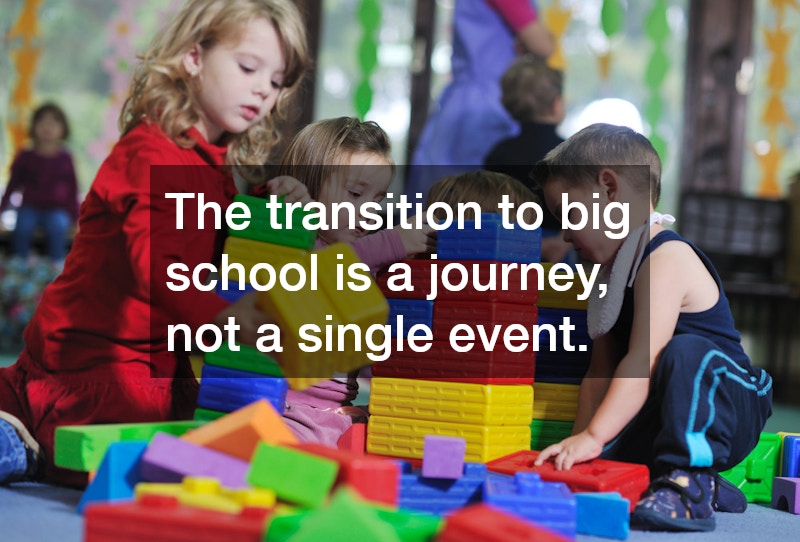
Executive function refers to the mental processes that enable us to plan, focus attention and juggle multiple tasks. Early educators design activities that build these ‘brain muscles.’ For example, a complex block-building project requires a child to plan a structure, solve problems when it collapses and persist until it is finished. These are the exact skills required for mathematical problem-solving and literacy tasks in Foundation (Prep/Kindergarten).
Literacy and numeracy are introduced through ‘print-rich’ environments and everyday experiences. Counting the number of children present for morning tea or recognizing their name on a locker helps children understand that symbols and numbers have real-world meaning, making formal instruction in school much more intuitive.
Physical Development & Fine Motor Strength
A child’s ability to succeed in the classroom is also tied to their physical development. School readiness involves both ‘gross motor’ skills (running, balancing and coordination) and ‘fine motor’ skills (the small muscle movements in the hands).
Without sufficient core strength, a child may struggle to sit upright on the floor during ‘mat time.’ Without fine motor strength, the act of holding a pencil becomes exhausting, leading to a quick loss of interest in writing. Early learning programs incorporate play-dough manipulation, bead threading and scissor skills to ensure that when a child is asked to write their first sentence at school, their hands are physically capable of the task.
The transition to big school is a journey, not a single event. By focusing on the emotional, social and physical pillars of development, early learning programs ensure that children don’t just survive their first year of school—they thrive in it. When the foundation is laid correctly, children enter the Australian school system with a sense of agency, a love for discovery and the confidence to say, “I can do this.” Through the dedicated work of educators in early childhood settings, our youngest learners are given the best possible start to their formal education.